For my travels this year, I made a promise to myself. I was going to explore beyond Oaxaca, CDMX, and North Baja. My goal was to dive deeper into into the places and flavours of México.
The idea of a beach week in Cancún became the launch point, and from there, I built a trip to explore new. First off was Mérida.
It began with a bus ride, my first in México, on the surprisingly comfortable ADO Platino. It was spacious, calm, and a slower way to arrive. I came with a list of Yucatecan dishes, all new flavours to discover and four days to chase them.
I arrived not to the heat I’d expected, but a damp, cool air that slowed everything down just enough to notice more. It set the tone for the days that followed, where everything I’d come to taste began to take shape.
Knowing I’d have a lot of down time between eating, I chose to stay at the lovely Cigno Hotel.


What drew me to Mérida was the chance to experience Yucatecan food in different forms. From panuchos and salbutes eaten simply to the more refined interpretations at Néctar and Ixi’im. Different settings, but flavours that always felt rooted in place.
A cold, rainy first walk through town led me to a bowl of sopa de lima at Manjar Blanco. Lighter and brighter than a tortilla soup, but still deeply soulful. Alongside, I ordered poc chuc, thin pork slices marinated in citrus and grilled. While flavourful, I felt the meat was a bit dry. But tastes of each were enough to carry me through to dinner.


My first dinner was at Néctar, my first opportunity to see how the region’s flavours could shift from casual to elevated. Opened by Chef Roberto Solís in the early 2000s, Néctar helped define what’s now often referred to as modern Yucatecan cuisine, taking deeply traditional flavours and techniques and presenting them through a more contemporary lens.
The menu reflected that approach throughout. Regional ingredients, recados, and familiar flavour combinations reworked into something lighter and more refined, without losing their connection to place.
I’d come for one dish in particular, the recado negro tempura onion, but the menu made it difficult to stay focused. Nearly everything sounded enticing, balancing Yucatecan flavours with combinations and techniques that felt more unexpected
The pork belly with grilled pineapple, served with handmade tortillas was rich but balanced. The róbalo tiradito with mango, leche de tigre and habanero sorbet was clean and bright. And the black onion with recado negro tempura was deep, smoky, but unexpectedly light. I had high expectations for the onion which were exceeded. It felt like an incredible introduction to the Yucatán and looked forward to everything that would follow.


Looking into the kitchen that night, I recognized Alex Burgos that I knew from Los Danzantes in Oaxaca. It was an unexpected comforting connection of familiarity, even as I was trying to explore something new.

The next morning, we wandered towards Mercado de Santiago and found our way to La Lupita, renowned for their cochinita pibil. While generally eaten as a taco, panuchos and salbutes, both iconic Yucatecan antojitos, were what I’d come for.
Panuchos are thick tortillas split, stuffed with refried beans and then fried. Salbutes are similar, just not stuffed. Both are served topped with pickled onions, layered meat and meant to be eaten quickly. I tried both with lechón and cochinita pibil.
I’ll admit, cochinita had never really been my thing as I tend to shy away from stringy meats, but here it was different. Moist, bright with citrus, the richness cut just enough to keep it balanced. The lechón though, was what stayed with me. It was deep, rich, and fatty, topped with crisp chicharrón that added a great contrast.


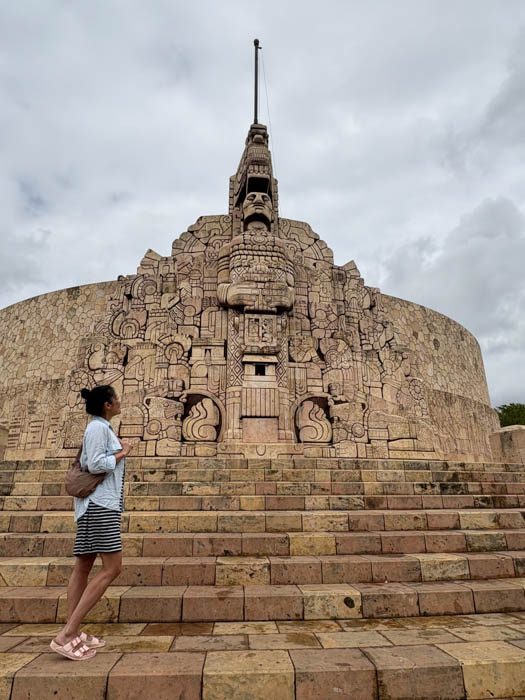
To work off the porky richness, the rest of the morning was spent walking through the city, down Paseo de Montejo and to Monumento a La Patria. It was a jaunt much needed to build up an appetite for my bigger meal ahead.


As I planned the trip to Mérida, I realized that one of the best things about Mérida was getting outside the city to explore beyond. Late lunch at Ixi’im gave me a reason to do just so.
I’d seen their take on pib roasted pork on Eva Longoria’s Beyond Mexico and was curious to try it. But just as much of a draw was the setting. The grounds of Chablé Yucatán, a restored hacienda, looked incredible and I wanted to experience it.
The drive out of the city felt like a reset. The day was gloomy, but it only made the greenery feel more lush. The grounds of Chablé did not disappoint and made for a grand entrance into the restaurant.


The dining room at Ixi’im is wrapped in glass, and looks out onto the lush grounds set within dense greenery. Even under grey skies, it felt calm and expansive. Seated, I started with a cocktail, something to sip slowly, not wanting to rush the experience.


The meal followed that same rhythm. It was unhurried and composed. Each dish felt connected to what I’d been tasting in the city, but expressed with more precision.
To start was a deeply layered tamal colado with short rib and mole negro. Next came a calabaza cooked pib-style, paired with subtley nutty and earthy sikil pak made of toasted pepitas. The pescado with recado rojo, carried a depth of flavour but in light contrast to the star of the show.


Ixi’im’s cochinita pibil took a different form. Rather than the usual pulled shoulder, theirs was pork jowl, richer and more structured. The shatteringly crisp skin added the perfect contrast. It was the dish I came for, and again my high expectations were exceeded.


At Ixi’im, everything slowed down. The setting, the pacing of the meal, even the way the flavours revealed themselves. Refined, yes, but still unmistakably rooted in the Yucatán.


After returning to the city, we didn’t feel the need to go back out again. The bar at Hotel Cigno was welcoming and was more than enough. A margarita in hand and a few small bites were an easy end for the night.


The next day, we took a break from eating and went in search of cenotes. I wanted something quieter, less crowded, and arriving early, found both Cenote Kankirixché and Cenote X’batún completely empty. The experience was exactly what I was searching for. Still, silent, and incredibly personal.
Kankirixché in particular was relevatory. A walk deep into the cave with bats overhead, I was skeptical. But the crystal clear water with its gradient of bright blues and then unexpectedly warm water filled me with profound wonder.


X’batun felt softer as it was open to the sky. Surrounded by a thick low jungle, I was filled with a calmness as I connected with the earth.


It felt like a reset heading back into Mérida and I was ready to return to the table. I still had a few things on my Yucatecan food list I wanted to try. I visited Chaya Maya for lunch, hoping I’d find good versions of what I was looking for.
I ordered salbutes topped with relleno negro and cochinita pibil. The relleno negro was complex, dark and almost smokey but didn’t overwhelm. It was a dish that I understood had regional significance, but wouldn’t run back to.

My last night in Mérida began at Agua de Mar, a relaxed seafood forward spot with an easy energy that felt right for the end of our time the city.


There was so much from their small plate menu I wanted to try but settled with the koji carrots, baby corn, a fresh fish crudo and brochettes. All the dishes were simple but bright and impressively flavorful. It’s a spot to eat casually but very well.


From there, we made our way to La Negrita Cantina, where the mood shifted completely. Lively, loud and filled with music and people. One last drink with some fun live music was a fitting way to close out Mérida.


Mérida pushed me outside of what I knew of México, which was the point of this trip. It moved at a different pace, expressed itself through deeper, more layered flavours and rewarded me for my slower kind of attention. It wasn’t a place that revealed itself all at once, but through meals and moment at all ends of the spectrum.
The places I visited in this post: